 CMSC388J
REST API Design Practices
I need to take a rest
HTTP / HTTPS
HTTP is the core protocol allowing computers to exchange information between nodes in a network. It is the thing that enables your computer to access a webpage. APIs use HTTP to carry requests and responses like web browsers do when getting pages.
"I get a page, post an update, delete a photo, put up information."
GET requests fetch information from a website/server. “GET” asks a site to send you a specific resource without changing anything. It includes - getting [a resource] + target machine [link]
POST requests send updated info to a server. Posting [updated info usually in body of form data] + target machine [website link] “POST” lets you submit forms or upload new data by sending info in the request body.
All REST APIs speak the same basic language, making them easier to use and swap. Resources have unique addresses (URIs), and can be retrieved/manipulated using standard methods. REST enables each item or service in it to have a unique link—simple and direct to access or change.
What is REST and why might you need it?
REST stands for “Representational State Transfer.”. Essentially, it lets clients reference resources; each reply updates the client’s “state” based on new data. Accessing resources via REST moves the client to new states.
REST is a design pattern, not a formal standard, which means it's a flexible guideline for designing web APIs, but not a strict technology or format.
Web Infrastructure
Firewalls help with web security. Routers help with web scalability. Caches help with web efficiency.
Case Study: Parts Web Store
Let’s see what REST looks like in a real system.
Scenario: Parts Depot, Inc. wants to design a web service that allows customers to:
- GET a list of all parts.
- GET detailed information about individual parts.
- POST a purchase order (PO).
Approach
In REST, each resource is identified by a URI (Uniform Resource Identifier). Clients interact with those resources using HTTP verbs, and the server responds with representations (like JSON or XML) that describe them.
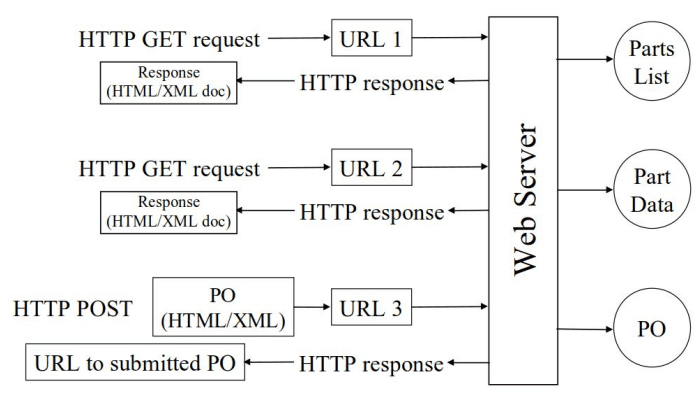
This means:
- The client doesn’t need to know how the server stores parts, just the URL structure.
- The same verbs (
GET,POST,PUT,DELETE) apply to every resource.
Representation
A client would retrieve the parts list by sending a GET request to: http://www.parts-depot.com/parts
The server responds with a representation (in this case, XML) describing the /parts resource.
This follows the REST principle:
Create a resource for every service, and identify each resource using a URI.
Networked Information
The data returned by the /parts endpoint might look like this:
<?xml version="1.0"?>
<Parts>
 <Part id="00345" href="http://www.parts-depot.com/parts/00345"/>
 <Part id="00346" href="http://www.parts-depot.com/parts/00346"/>
 <Part id="00347" href="http://www.parts-depot.com/parts/00347"/>
 <Part id="00348" href="http://www.parts-depot.com/parts/00348"/>
</Parts>
Notice that each <Part> element links to another resource.
When a client follows one of those links — for example:
GET http://www.parts-depot.com/parts/00345—it receives a new representation describing that individual part, which may itself contain links to related resources (like a specification or pricing information).
This demonstrates another REST principle:
Data returned by a service should link to other data. Each response should act as a “map” of the system, letting the client discover related resources through hyperlinks, just like how users navigate a website.
Idempotency
An operation is idempotent if performing it multiple times has the same effect as performing it once.
In REST, this property ensures that repeating a request leads to the same response and state.
Idempotency is essential for reliability, as network failures, retries, or concurrent clients can cause duplicate requests. Clients, load balancers, and proxies are allowed to safely resend requests without issue.
Rules of thumb:
GETis safe: it reads, but does not write or modify resources.PUTandDELETEare idempotent: repeated calls have the same effect.POSTis not idempotent: multiple identical posts can create duplicates and must be handled carefully.
Statelessness
Another core principle of REST is that:
Each request contains all the information needed to service the request.
This is because server does not store client state. In other words, every interaction between a client and server is independent and self-contained.
This design keeps RESTful systems scalable and highly available:
- Any server can handle any request
- Servers can be easily replaced or replicated to meet demand
- Failures are isolated
However, statelessness can come with tradeoffs.
Without a state, the client will need to send extra data or make multiple requests for certain workflows.
Physical vs. Logical URIs
Going back to the Parts Depot: if the store sells a million parts, should there be a million static pages?
http://www.parts-depot.com/parts/000001
http://www.parts-depot.com/parts/000002
...
http://www.parts-depot.com/parts/999999
In a RESTful system, these URLs are logical, not physical.
Instead of pointing to static HTML files, they identify resources that the server dynamically generates.
When a client requests /parts/00345, the server looks up the part in a database and returns a representation (e.g., XML or JSON), that can then be passed to a Jinja template.
This design keeps clients loosely coupled from implementation details. The resource’s location, format, etc. can change, but the URI stays the same. Clients asks without thinking.